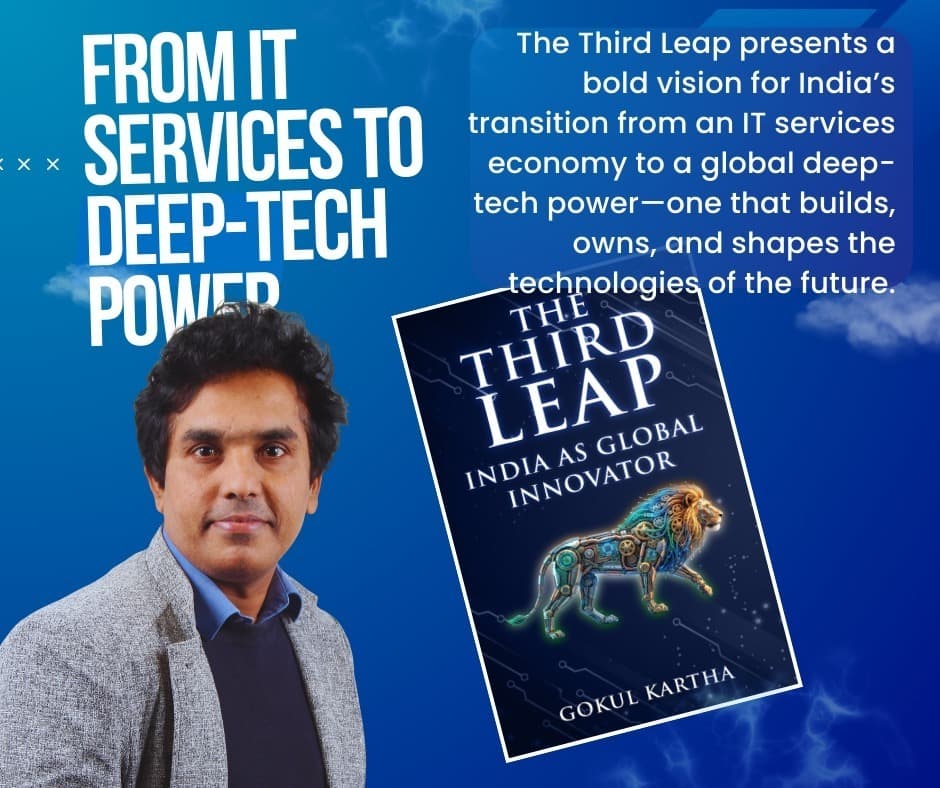
In an era where technological leadership increasingly defines economic and geopolitical strength, the question of which nation will shape the next wave of innovation has become central to global conversations. While Silicon Valley and a handful of Western hubs have long dominated deep-tech innovation, technologist, entrepreneur, and author Gokul Kartha argues that the next major shift could come from India. In his book The Third Leap, Kartha presents a compelling roadmap for India to transition from a services-driven IT economy to a global leader in deep-tech innovation—one that designs, builds, and owns the technologies that will shape the coming decades.
Gokul Kartha’s professional journey spans multiple continents and technology ecosystems. Born in Kerala, India, with limited access to early computing resources, he pursued technology through determination and self-learning. His career later took him to Finland, Germany, South Korea, and the Netherlands, where he worked on complex engineering challenges across embedded systems, automotive software, cloud platforms, and artificial intelligence. Over the years, Kartha has led teams building large-scale systems in highly regulated and mission-critical environments. These global experiences form the foundation of The Third Leap, which combines hands-on engineering insight with a broader national vision for India’s technological future.
India’s first major technological leap positioned the country as a global IT services powerhouse. The second phase saw widespread digital adoption, infrastructure growth, and a booming consumer technology market. However, Kartha argues that these achievements, while significant, are not sufficient for long-term global leadership. India’s next transformation, he believes, must be a third leap—one that moves beyond services and consumption toward deep ownership of core technologies. In The Third Leap, Kartha emphasizes that leadership in areas such as artificial intelligence, robotics, semiconductors, quantum computing, and advanced manufacturing is essential not only for economic growth, but for national strength and strategic independence. As he writes, “India’s next leap will not come from outsourcing or services. It will come from building, inventing, and owning the technologies that define the future.”
Rather than offering abstract optimism, The Third Leap outlines a practical framework for India’s evolution into a deep-tech nation. According to Kartha, success in this phase depends on two foundational pillars: talent development and innovation infrastructure. India possesses one of the world’s largest and youngest talent pools, but Kartha argues that the education and skill-development systems must evolve. While the existing model has produced a strong services workforce, the deep-tech era demands engineers, scientists, and entrepreneurs capable of original research, product invention, and long-term system thinking. “Deep-tech is not just an industry,” Kartha notes. “It is a national capability.” He calls for a renewed focus on research-oriented education, interdisciplinary learning, and environments that encourage experimentation and failure—critical ingredients for genuine innovation.
Beyond talent, Kartha stresses the importance of a resilient innovation ecosystem. This includes world-class research institutions, strong collaboration between academia and industry, and public policies that actively support long-term technological bets. Government investment in strategic domains, coupled with private-sector entrepreneurship and startup scaling, is essential. According to Kartha, deep-tech leadership emerges not from isolated success stories, but from sustained ecosystem-level alignment.
Kartha’s ideas are shaped by extensive real-world engineering experience across embedded systems, automotive software, and large-scale platform development. Over the years, he has contributed to several practical frameworks and open initiatives, including ReAgile, a remote-first engineering methodology designed for globally distributed teams, and OpenRoadSim, an open platform created to simulate in-car features and system behavior in the context of Software-Defined Vehicles (SDV). His work in the SDV domain reflects a broader commitment to building foundational tooling rather than relying solely on proprietary ecosystems. Kartha has also been an active contributor to open-source communities, including initiatives around Ubuntu Touch and Linux-based platforms, advocating for transparent, extensible, and community-driven technology development.
The Third Leap is not merely a technology book; it is a call to action. Kartha argues that India stands at a decisive moment. Nations that lead in deep-tech will define future economic power, security, and influence, and India has the scale, talent, and ambition to be among them—if it chooses to act decisively. “A nation becomes a global power not by consuming innovation, but by creating it,” he writes. The book urges policymakers, entrepreneurs, engineers, and educators to think beyond short-term gains and commit to building long-lasting technological foundations.
At its core, The Third Leap is about more than technology or economics. It is about confidence, national imagination, and the belief that India can shape the global future rather than merely follow it. Kartha frames India’s deep-tech rise as a collective journey—one that empowers individuals, institutions, and communities to participate in building a more innovative, self-reliant nation.
The Third Leap offers a clear vision and actionable insights for India’s transformation into a global deep-tech powerhouse. By combining global engineering experience with a grounded understanding of India’s strengths and challenges, Gokul Kartha presents a roadmap for how the country can move from technology consumption to technology leadership. India’s third leap is waiting to be made.
For more information about Gokul Kartha’s vision for India’s deep-tech transformation, visit his website at gokulkartha.com | www.techysaint.com , and follow his journey on LinkedIn and Instagram.