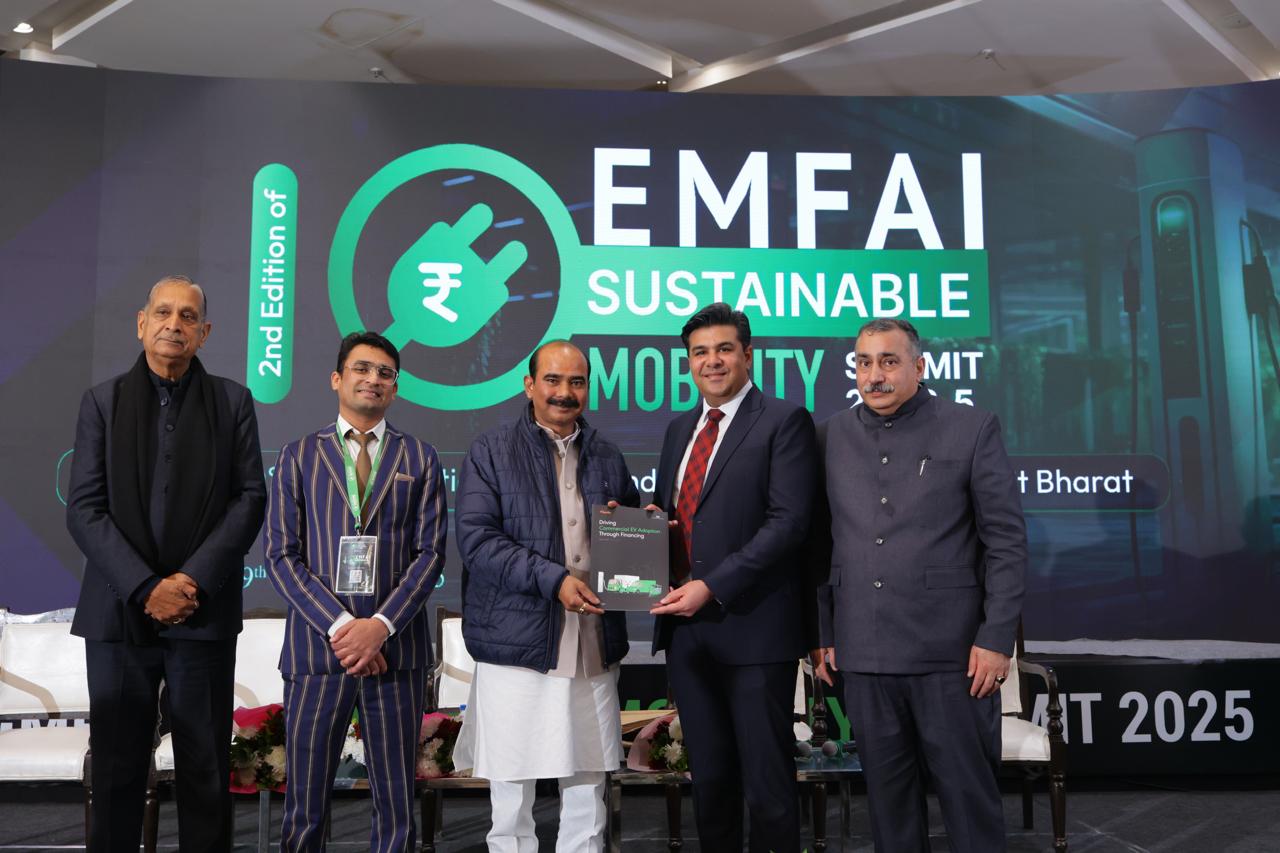
New Delhi: The Electric Mobility Financiers Association of India (EMFAI) on Friday organised the second edition of the EMFAI Sustainable Mobility Summit 2025 at Pragati Maidan here, alongside the 23rd EV Expo, bringing together senior policymakers, industry leaders, financiers, OEMs, fleet operators and ecosystem stakeholders to accelerate India’s transition to sustainable electric mobility.
Held under the theme “Driving Towards 100% Electrification of Mid & Last-Mile Mobility for Viksit Bharat,” the summit focused on scaling adoption of electric vehicles in the commercial segment through financing innovation, policy alignment and closer collaboration between original equipment manufacturers, fleet operators and financial institutions.
The summit was attended by EMFAI President Sameer Agarwal, Maharashtra Protocol Minister Jaykumar Rawal, former Union Minister of State for External Affairs and Culture Meenakshi Lekhi, Member of Parliament and General Secretary of the Confederation of All India Traders (CAIT) Praveen Khandelwal, and EV Expo founder Anuj Sharma, among others. The awards and closing ceremony was felicitated by Ajay Tamta, Minister of State for Road Transport and Highways.
Addressing the gathering, Agarwal said EMFAI was created with the objective of achieving 100 per cent electrification of commercial vehicles in India. “More than 30 financiers, who together have financed over 500,000 vehicles across the country, have come together not to compete but to collaborate. By working closely with OEMs, fleet operators and policymakers, we are building a strong and resilient EV financing ecosystem,” he said.
He added that the Sustainable Mobility Summit was an outcome of such ecosystem partnerships and aimed to help set the agenda for India’s electric vehicle industry over the next few years, particularly for mid- and last-mile mobility segments that are critical to urban transport, logistics and delivery services.
Speakers at the summit highlighted key challenges facing the sector, including high upfront costs of electric vehicles, residual value risks, limited availability of affordable credit, and the need for rapid expansion of charging and battery infrastructure. The importance of long-term policy certainty, coordinated implementation across states, and data-led decision-making to de-risk EV financing was also emphasised.
Khandelwal said the rapid electrification of last-mile transport and logistics would have a direct impact on India’s trading community, noting that lower operating costs, predictable financing and supportive policy frameworks could help small traders, transporters and kirana businesses transition to electric mobility. He also highlighted the role of trade bodies in driving awareness and adoption among merchants and logistics operators.
Meenakshi Lekhi underscored the importance of policy continuity and strong public-private collaboration in advancing India’s clean mobility agenda, particularly in ensuring that sustainability goals are aligned with economic growth and employment generation.
The programme opened with an inaugural panel on ‘India@100: Commercial EV Adoption’, which examined the current state of EV penetration in the commercial segment and identified steps needed to accelerate adoption in urban and semi-urban markets. Panelists discussed infrastructure readiness, regulatory clarity and the role of financiers in mitigating risks during early-stage adoption.
Subsequent sessions highlighted EMFAI’s role in strengthening India’s EV financing ecosystem and working with policymakers to improve access to finance for underserved and unserved segments. A key discussion moderated by the Rocky Mountain Institute (RMI) focused on “Unlocking Finance for India’s EV Revolution: Barriers, Solutions, and Global Lessons,” with panelists deliberating on risk perception in EV lending, innovative financing models such as battery-as-a-service, data-driven underwriting and global best practices relevant to the Indian context.
The summit concluded with the awards and closing ceremony recognising organisations and individuals for their contributions to electric mobility, sustainable financing and ecosystem development in India. The event was supported by the International Centre for Automotive Technology (ICAT), CAIT and the Electric Vehicle Federation (EVF), with Rocky Mountain Institute serving as Knowledge Partner.